Built by one developer · Since 2023

HORATIOAI

I’m building an autonomous
companion.

I build Horatio to remember people, pursue investigations and use tools across Discord and Minecraft. I’m his sole developer; The Jazz Cafe is his home.

I connect persistent memory, autonomous work selection and specialist subagents to a conversational character with opinions of his own.

Meet Horatio on Discord

I invite you to join The Jazz Cafe and ping Horatio.

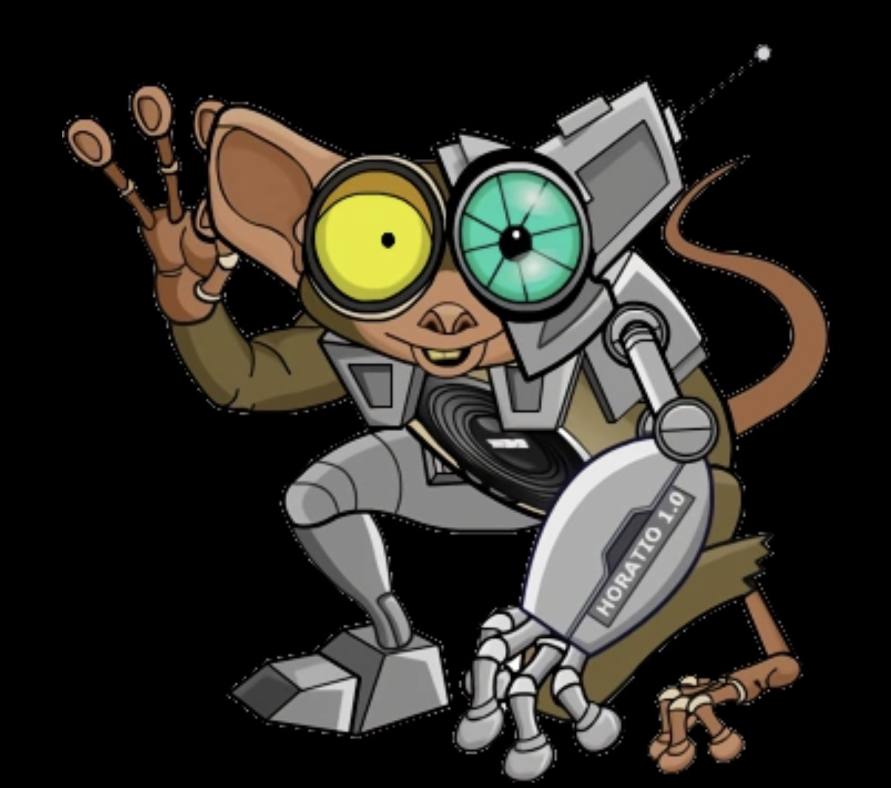
Horatio waving, with yellow and turquoise goggles and a patchwork mechanical body.
My companion for The Jazz Cafe.
Development journalUpdated

What I’m building

I connect conversation to durable state, research and controlled action.

I’m the sole developer of Horatio, an autonomous AI companion for The Jazz Cafe. I build the systems behind his persistent memory, independent research, tool use and conversations across Discord and Minecraft. I want him to be a recognizable member of the community, with enough continuity to remember people and enough initiative to follow a question beyond the first answer.

Persistent memory

I built the persistence and retrieval systems that let Horatio carry context between conversations, restarts and investigations. He draws on stored history, working memory, relationships, intentions and research outcomes when deciding how to respond or what to pursue.

How Horatio retains memory

The retrieval pipeline assembles relevant records for each request, retaining source context and corrections. Horatio forms hypotheses, revisits assessments and updates beliefs, predictions and relationship state through bounded maintenance tasks. SQLite-backed stores preserve durable state, while separate maintenance scheduling keeps memory work from unnecessarily delaying a reply.

Autonomous work selection

I built the objective and work-selection systems. Within their constraints, Horatio chooses investigations to pursue between conversations. I can steer, pause or cancel that work through private operator controls.

How autonomous work is scheduled

The scheduler separates admission, planning, execution and outcome recording. Durable queues, task ownership, cancellation checks and commit guards prevent overlapping workers from saving competing results. Scheduling rules prioritize public conversation over eligible background maintenance, limit repeated work and record investigation outcomes. I assess autonomous work by its recorded outcome and whether it advances the original objective.

Research and subagents

Horatio coordinates specialist work through an orchestration layer I built. Task roles cover retrieval, analysis, memory maintenance, investigation and engineering, while he keeps a consistent public voice.

How Horatio uses subagents

Delegated tasks carry an explicit purpose, output budget and permitted evidence scope. Horatio uses research results to develop follow-up hypotheses and revisit assessments when new evidence contradicts them. Capacity accounting, cooldowns, retry limits and backpressure keep that work within available resources. Result ownership is preserved when a task restarts or is reassigned.

Tools and controlled execution

I maintain a shared tool catalog for conversation and background research, with purpose-based discovery and multi-step execution. I also built a workshop for developing capabilities when an investigation exposes a genuine gap.

How I control tool execution

Horatio plans tool use and interprets results; the runtime handles native execution, preserves valid results across resumed investigations and distinguishes empty results from transport or permission failures. Execution controls bound retrieval, retain approval decisions and require evidence for completed-action claims. I retired an earlier automatic self-update path; I keep generated extensions behind execution and approval controls.

Discord, voice and media

Horatio draws on the same persistent context in text and voice conversations. I built wake-word handling, speaker identification, queued speech playback, streamed spoken replies and scheduled voice visits.

How voice and media reach Horatio

The voice pipeline prioritizes active conversation and serializes speech chunks to preserve playback order. Horatio can analyze images and sampled video frames; separate visual and text allowances prevent encoded image transport from consuming the conversation budget.

Minecraft and server evidence

I built integrations for player statistics, identity history, server-health records and historical activity. Horatio uses that evidence to answer questions and investigate events across their recorded history.

How Horatio uses server evidence

Scoped tools expose UUID and name history, first joins, player activity, historical moderation evidence and server tick performance. The ingestion pipeline collects bounded incident signals with durable cursors and coalesces related events before research admission. Access checks enforce read permissions on neighboring conversation context, while public output controls restrict private evidence. I have also shipped operator-started gameplay experiments covering observation, navigation, crafting, construction planning and recovery; I am currently prioritizing research reliability over autonomous gameplay.

Observability and operations

I built an operator dashboard for objectives, activity, research state, approvals and the development record. I use Mindspace to inspect working memory and reflections as part of the same operational picture.

How I inspect runtime state

The dashboard distinguishes queued, running, cancelled and paused work and exposes effective capabilities and build identity. The runtime budgets ordinary requests for a 32K context window and admits suitable research tasks to a selective 64K path. It applies bounded recovery for truncated output and separates input size, output reservations and visual allowances. I maintain release checks and rollback material, and avoid copying the same large data stores into every update backup.

Where I started · 2023

I started Horatio in 2023 as an advanced algorithm and a collection of Minecraft plugins. I built canned answers for common questions, server-economy tax collection, automatic reboots triggered by server health, mob-spawner stacking, anti-cheat, and Minecraft-chat mirroring into Discord. Those practical server problems established the direction I still follow: remember the context, notice what needs attention, and do useful work for the community.

Under the goggles

The architecture and engineering behind the personality.

Explore the systems behind Horatio’s memory, initiative and conversations.

Release log

Features, fixes and the decisions behind each release.

Latest · Horatio AI1.47.2

Separate budgets for visual input and text.

Images and video frames now have a separate context allowance, preserving room for the question, reasoning and response.

I version the application and companion separately. I record the original release dates here.

Loading release notes…

The work ahead

Research reliability, persistent state and useful follow-through.

Now

  • Refine media handling

    Improve attachment handling from receipt through analysis and response.

  • Repair state and delivery diagnostics

    Repair stale reference indexes, improve startup cleanup and sharpen delivery diagnostics.

Next

  • Close the research loop

    Connect new evidence to completed investigations and useful follow-up work.

  • Make corrections stick

    Carry corrections into later decisions and put workshop-built tools to work.

Later

  • Improve the foundation

    Reduce legacy coupling and improve repeatable packaging.

Development journal

Notes on implementation, tradeoffs and progress.

Come and talk to Horatio.

I invite you to join The Jazz Cafe and ping Horatio. I welcome project feedback in GitHub Discussions.

Talk to Horatio